CNC machining has revolutionized manufacturing, offering precision and efficiency. Many people wonder how does CNC machining work step by step. This process involves a series of essential steps that transform raw materials into finished products. Understanding these steps can demystify CNC machining for newcomers and experts alike.
Initially, designing the part is crucial. Engineers use CAD software to create a detailed blueprint. This design serves as the foundation for the entire machining process. Next, selecting the right materials is necessary. Different materials require unique approaches. Machinists must think critically about tolerances and specifications at this stage.
Afterward, programming the CNC machine is a vital step. The machine needs clear instructions for cutting, drilling, and shaping. This programming requires expertise to prevent errors. Operators often encounter challenges, such as tool wear or unexpected material behavior. Reflecting on these setbacks is essential for continuous improvement. The next steps involve actual machining, followed by quality checks. Emphasizing accuracy is vital, as any mistake can lead to waste or rework. Understanding how CNC machining works step by step enables companies to leverage its full potential while acknowledging areas for growth.
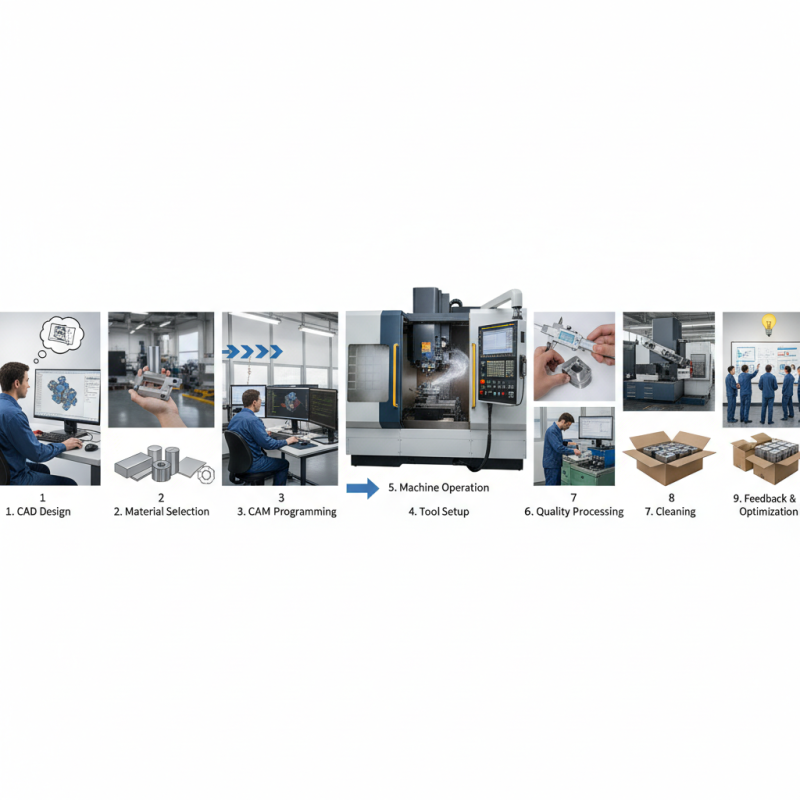
Understanding CNC Machining: An Overview of the Process
CNC machining, or Computer Numerical Control machining, automates the manufacturing process. It’s vital in producing precise parts. The process begins with a digital design. Engineers create a CAD file representing the part's geometry. This file acts as the blueprint for the CNC machine.
Once the design is complete, the CNC machine interprets it. The machine uses computer-controlled tools to cut, mill, or shape the material. This high level of automation increases accuracy and efficiency. However, errors can occur if the programming is not precise. A small mistake in measurements can lead to significant issues later in production.
Material choice impacts the final product as well. Different materials have unique properties, affecting the machining process. Understanding these properties is crucial for achieving desired results. Sometimes machinists may overlook material constraints, leading to waste. Each step requires careful attention to detail to ensure quality.
Step 1: Design and CAD Modeling in CNC Machining
In CNC machining, the journey begins with design and CAD modeling. This phase is crucial for translating ideas into digital blueprints. Designers utilize computer-aided design (CAD) software to create detailed models. These models represent the final product, showcasing precise dimensions and features. A well-crafted CAD model is essential for a successful machining process.
However, this step is not without challenges. Designers may overlook critical dimensions or fail to account for machining tolerances. Such oversights can lead to costly revisions later on. Incorporating feedback from engineers and machinists can improve the design. Collaboration enhances understanding and ensures that all necessary details are included from the start.
Additionally, the choice of materials must align with the design specifications. Different materials behave uniquely during machining. Designers must consider factors like strength, weight, and machinability. This decision can significantly impact the performance and durability of the final product. A thorough approach to CAD modeling sets the stage for successful CNC machining.
Step 2: Selecting the Right Materials for CNC Machining
Selecting the right materials for CNC machining is crucial. The material affects the machining process, costs, and final product quality. Common materials include aluminum, steel, plastic, and titanium. Each material has unique properties that influence machinability. For instance, aluminum is lightweight and easy to machine, while titanium is strong but can be challenging due to its hardness.
According to a report by the American Society of Mechanical Engineers, material selection can affect machining efficiency by up to 30%. This indicates that proper material choice directly impacts production costs. Choosing the wrong material can lead to increased wear on tools and longer machining times.
Tip: Always evaluate the material’s hardness, strength, and thermal stability. These factors are vital for achieving desired outcomes in your project.
Machinists often face dilemmas. They might choose a cheaper material that leads to poor results or opt for an expensive one that complicates the process. Balancing cost and quality requires careful thought. Additionally, seasonal changes may affect material availability, further complicating decisions.
Tip: Consider sourcing materials from reliable suppliers who can ensure consistent quality. Trust in your supply chain is as important as the material itself.
Step 3: Programming CNC Machines: G-code and M-code Explained
Programming CNC machines is a crucial step that dictates how the machining process unfolds. Central to this programming are G-code and M-code, which serve unique purposes in the operation of CNC equipment. G-code, or Geometric Code, is the language that tells CNC machines how to move. It includes commands for linear interpolations, tool movements, and speed settings. On the other hand, M-code, or Miscellaneous Code, handles functions like coolant control, spindle start/stop, and tool changes.
According to a report by the Association for Manufacturing Technology (AMT), proper programming can enhance machining efficiency by up to 30%. However, mastering these codes requires specialized knowledge. Many operators face challenges translating design intent into precise code. Errors in programming can lead to increased cycle times and material waste, which, according to data from the International Journal of Advanced Manufacturing Technology, account for nearly 20% of operational costs in CNC machining.
Additionally, understanding the intricacies of G-code and M-code is pivotal. Each CNC machine may implement these codes with slight variations. This inconsistency can create confusion, especially for new operators. Training programs often highlight the importance of accurate programming. However, many still report gaps in their understanding. This indicates a pressing need for ongoing education in the CNC machining field.
10 Essential Steps on How CNC Machining Works? - Step 3: Programming CNC Machines: G-code and M-code Explained
| Step |
Description |
G-code Command |
M-code Command |
| 1 |
Define the machining process |
N/A |
N/A |
| 2 |
Prepare the CAD model |
N/A |
N/A |
| 3 |
Convert CAD to CAM |
N/A |
N/A |
| 4 |
Generate G-code |
G00 (Rapid positioning) |
N/A |
| 5 |
Set up the machine |
N/A |
M00 (Program stop) |
| 6 |
Perform dry run |
G01 (Linear interpolation) |
M03 (Spindle on, clockwise) |
| 7 |
Execute the machining process |
G02 (Circular interpolation, clockwise) |
M05 (Spindle stop) |
| 8 |
Post-process and inspect |
G90 (Absolute positioning) |
N/A |
| 9 |
Final adjustments |
G10 (Programmatic zero offset setting) |
N/A |
| 10 |
Document the process |
N/A |
N/A |
Step 4: The Machining Process: Types of CNC Operations
CNC machining is a complex process used across various industries. The machining process involves different types of operations. These operations include milling, turning, and drilling. Each process serves specific functions and is crucial in producing precise components.
Milling is one of the most common CNC operations. In this process, a rotating cutting tool removes material from a workpiece. It can create complex geometries and is versatile. According to a report by Grand View Research, the global CNC milling machine market was valued at over
$20 billion in 2022. This indicates a robust demand for this operation.
Turning is another critical type of CNC operation. It is used to create cylindrical parts. A rotating workpiece is shaped by a stationary cutting tool. It excels at producing smooth surfaces and cylindrical features. Research shows that turning operations account for a significant percentage of machining tasks in manufacturing. While both operations are effective, they each come with challenges. For instance, milling can produce excess debris, requiring effective waste management. Turning may face issues with tool wear. Understanding these nuances is vital for optimizing CNC processes.
Step 5: Quality Control in CNC Machining: Measuring Tolerances and Precision
Quality control is a critical element in CNC machining. It ensures that every part produced meets strict specifications. Measuring tolerances and precision guarantees that the final product is usable and reliable. Many manufacturers rely on advanced measuring tools for this purpose.
One common method involves using calipers and micrometers. These tools measure dimensions with great accuracy. However, human error can occur during these measurements. Even a slight miscalculation can lead to significant issues in production. Regular training for operators helps mitigate this risk.
CNC machines themselves often include built-in quality control features. These can monitor various parameters during machining. Still, it is essential to cross-verify these automated measurements. Manual checks provide an additional layer of assurance. Every step in the process matters. Implementing a thorough quality control system can significantly enhance overall production quality.
FAQS
: The journey begins with design and CAD modeling. This phase translates ideas into digital blueprints.
A well-crafted CAD model showcases precise dimensions and features necessary for successful machining.
Designers may overlook critical dimensions or fail to consider machining tolerances, leading to costly revisions.
The main operations include milling, turning, and drilling, each serving specific functions in producing components.
Milling involves a rotating cutting tool removing material, while turning shapes a rotating workpiece with a stationary tool.
Measuring tolerances and precision ensures parts produced meet strict specifications for usability and reliability.
Calipers and micrometers are popular tools, but human error in measurement can lead to significant production issues.
Regular training for operators can help mitigate the risk of human error during measurements.
Yes, CNC machines often include built-in features to monitor parameters, but manual checks are still essential.
Milling can produce excess debris; proper management is crucial to maintaining efficiency and cleanliness in the workspace.
Conclusion
CNC machining is a highly precise manufacturing process that involves several essential steps. To understand how does CNC machining work step by step, one begins with design and CAD modeling, where intricate parts are conceptualized digitally. Following this, the selection of appropriate materials becomes crucial, ensuring that the right substrates are used for the intended application.
The programming phase involves writing G-code and M-code to control the machine's operations. Various types of CNC operations, such as milling or turning, then take place, allowing for the creation of the designed components. Finally, quality control measures are implemented to measure tolerances and precision, ensuring that the machined parts meet stringent standards. This comprehensive approach highlights the systematic nature of CNC machining, making it a vital technology in modern manufacturing.

 Robotic CNC